Summer Newsletter

posted on

August 10, 2017

Hey Folks!

Summer has been very busy for us. Mariah and I had the opportunity to go to Michigan for a much needed get-away with family. Then on the way back we stopped by Seven Sons farm in Indiana. It was an incredible experience. They are very passionate about producing nutrient dense, pastured, GMO free food.  We learned so much during our visit. My favorite thing we saw was there was their pastured laying hen system. They have several hoop coops that they move together as a group. It was a pretty innovative idea. Mariah really liked the tour of the pastured hog operation. She has been considering starting a pastured pork enterprise for some time and this trip helped her better understand the necessary requirements for a pastured hog enterprise.  After a full day in rural Indiana we finally headed back for home. 

This summer has also been busy on the farm as we have been working hard to finish a fence and water development project. Unfortunately, it has taken much longer to finish than we had anticipated. In part, due to a two month delay in trenching for the water line. It was so unfortunate we just had to laugh. We hired a contractor to trench for us (to save the expense of buying or renting one, which would've required a lot more of my time to run the machine). The contractor was excited about the project and told us he could have all 14,000 feet trenched in two weeks. That was March. We were excited and quickly rearranged our schedules and hired a friend to help us install all the water line in the trench and build the tire tanks (picture in spring newsletter). Let us say that by the end of June and four trencher breakdowns (and subsequent long repairs) later, only 70% of the trenching was completed. It was a major set back that has made rotational grazing on this farm much more difficult due to limited water supplies. 

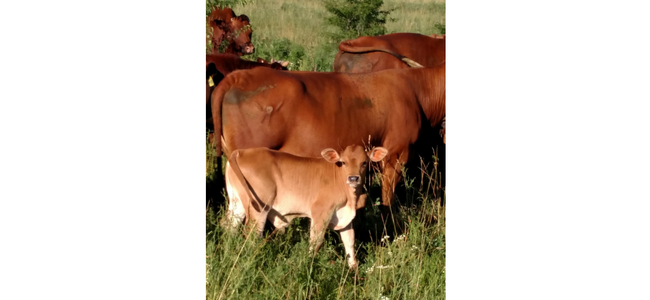
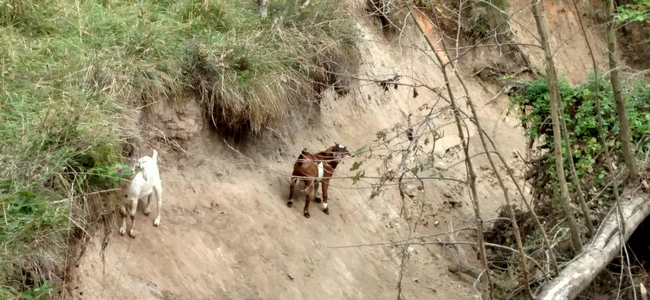
HOWEVER, we have been able to make the best of a not-so-good situation.  In spite of this set back, the cows and sheep are doing great. All the lambs are on the ground (shepherd slang for birthed and healthy) and they are growing fast! The spring calves are also growing fast.  Both the calves and lambs not to mention kids (baby goats) are providing lots of laughs with their love to climb and play. 

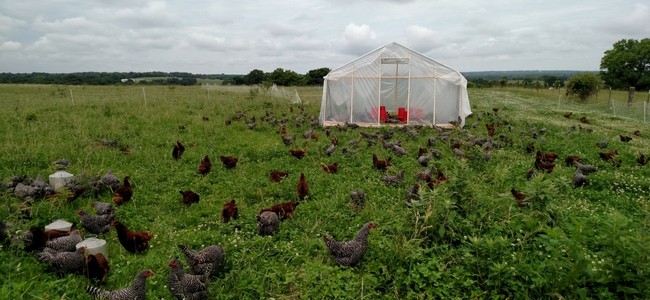
In last spring's newsletter, we showed a picture of tiny little chicks that we are just beginning to raise.  Those little black and white baby chicks finally grew up! Now we have an abundance of their small (pullet eggs).  We are giving them away for free.  Learn more here. The young hens lay these "pullet" eggs for several weeks when they first begin to lay. Their eggs will gradually grow in size as they age. The young hens are enjoying their new hoop coop which we pull across the fields (see picture below). 

In the midst of the craziness, we have added a couple new buying club locations in St. Louis and Kansas City. We will begin making deliveries in October.  If you know of anyone in those areas who needs nutrient dense, pasture raised, clean food (think everyone) let them know about us! 

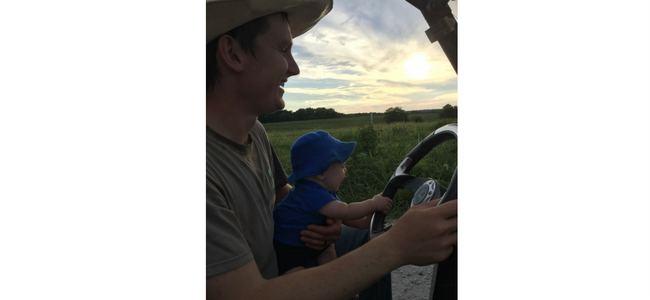
Last, but certainly not least, Judah is growing up. He loves to be outside on the farm playing in the grass, riding on the side by side (carefully restrained by us of course), and generally giggling at the animals (his favorite animal on the farm are the chickens). At only six months old he can crawl anywhere- and fast. He is already pulling himself up on his feet! We have had to make a few changes in the last few weeks (finding new places for magazines, books, trinkets, and computer cords), but we are so thrilled to have our little nugget. 

Check out the pictures below of Judah, the calves, lambs, and the chickens!

We hope you have all had great summers as well!

Your Farmers,

-David, Mariah, and Baby Judah
Untitled-design(41).png


Untitled-design(42).png


Untitled-design(43).png


Untitled-design(33).jpg


More from the blog

Our Hens Today

What did you think?One of my favorite things about the hens is just how friendly they are. They run up just to see what's new and haha to see if I scared up any bugs. It's not just great for the hens and the land though its also great for the families who enjoy our eggs. The result of this truly pasture raised regenerative model for raising hens is some incredibly nutrient rich eggs! Our growing family eats eggs for breakfast nearly every day but in spite of our 5 children's ravenous appetites for our eggs right now we have a seasonal abundance (it happens almost every Spring) and so we are offering  Free Eggs For A FriendThey are completely free.All we ask is that you don't use them for yourself, but instead give them away to family or friends that are really interested in nourishing their family well. It's a win win. They get to enjoy the best nutrient rich eggs available and get a connection to their very own farmer!Give Free Eggs For A Friend ==>NOTE (If you are currently utilizing our home delivery option for getting our pasture raised eggs since you can't order them singly, if you give one to bless another family just email myfarmers@fedfromthefarm.com and we can credit your account for you :)Thank you for supporting and sharing about our pasture based farm. It is an honor to serve you from our farm's bounty!

Our New Lake

On the farm, we plan out our regenerative grazing well ahead of time to ensure that the soil, plants, and livestock all benefit from the sybiotic relationships that exist from temporary peridic grazing between all three.Sometimes though the weather has other plans and we have to adapt. Haha case in point about two weeks ago we got just under 9 inches of rain in 36 hours. Now on our farm a majority of the rain still just soaked into the ground through healthy root channels and pore spaces from years of planned regenerative grazing. For farms for miles around us though most of that water quickly ran off and into creeks and rivers. This caused a creek on the back of our farm to flood well outside of its banks. When I went down that morning to check on the sheep I was quite surprised to see that we had a new lake on the farm!You see we have a 60 acre area of bottom ground (low elevation ground with deep soil near to a creek or river). When I got there about 25 acres was underwater!!! This was just part of it but you wan see the sheep's watering trough is underwater - haha they certainly weren't thirsty!Thankfully as the water rose the sheep just slowly meandered to the north to higher ground.  They do not like water at all and will not willingly ford even a shallow stream so I was quite glad they had not gotten cut off on one of the now islands of land that had just the day before been the higher areas of the low bottom fields!Later that afternoon, Judah and Ephraim went to look at our new lake and reported that they could not see the watering tank. I thought that was kind of strange but figured they just missed seeing it as it hadn't rained at all that day. As I pondered it for a few more hours though I got to thinking that they are actually very reliable little scouts and they know what it looks like. On a hunch I went back down there only to discover that upriver flooding had continued to pour more water into our bottom and we now had a 55 acre lake!!!!Everything in that video and pictures  that had been still land was now underwater and the sheep were at the very top of the field. A gate was promptly opened and they were let out of the low bottom fields completely onto the much drier upland fields. Thankfully everything was fine and stunningly the next day all the water had receded and our lake was gone. A new layer of top soil had been deposited on our thickly vegetated bottom fields as well which will be nice for long term fertility but in the short term made the forage quite muddy so even though we had originally planned for the sheep to graze those bottom fields for about two weeks (split into several 3-4 day subdivisions) they in fact only spent two days there. Well on the farm sometimes you just have to adapt and that's just what we did. We made a new grazing plan, skipped the rest of the bottoms for a few weeks until some rain could wash the dirt off of the grass and things could dry up a bit. Haha basically adapt and improvise. Thankfully the bottom does not flood very often (this is the first time in about 8 years) but when it does we can get a very large lake overnight + ducks :)I hope things aren't too wet your way.